Showing posts with label Labor Day. Show all posts

Sunday, September 4, 2016

#LaborDay special from the @precariousfac archives: "Salt of the Earth" (1954) + links


http://www.historynet.com/ah/saltoftheearth1.jpg
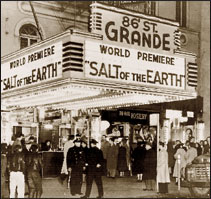
Salt of the Earth (1954) is an American drama film written by MichaelWilson, directed by Herbert J. Biberman, and produced by Paul Jarrico. All had been blacklisted by the Hollywood establishment due to their alleged involvement in communist politics. (Image: Library of Congress. March 14, 1954 premier at the only theater in the the city that would show it)

The film is one of the first pictures to advance the feminist social and political point of view. Its plot centers on a long and difficult strike, based on the 1951 strike against the Empire Zinc Company in Grant County, New Mexico. In the film, the company is identified as "Delaware Zinc," and the setting is "Zinctown, New Mexico." The film shows how the miners, the company, and the police react during the strike. In neorealist style, the producers and director used actual miners and their families as actors in the film. The film was called subversive and blacklisted because the International Union of Mine, Mill and Smelter Workers sponsored it and many blacklisted Hollywood professionals helped produce it.


Monday, September 1, 2014

#LaborDay Movie: "Salt of the Earth" (1954)

http://www.historynet.com/ah/saltoftheearth1.jpgSalt of the Earth (1954) is an American drama film written by Michael Wilson, directed by Herbert J. Biberman, and produced by Paul Jarrico. All had been blacklisted by the Hollywood establishment due to their alleged involvement in communist politics. (Image: Library of Congress. March 14, 1954 premier at the only theater in the the city that would show it)

The film is one of the first pictures to advance the feminist social and political point of view. Its plot centers on a long and difficult strike, based on the 1951 strike against the Empire Zinc Company in Grant County, New Mexico. In the film, the company is identified as "Delaware Zinc," and the setting is "Zinctown, New Mexico." The film shows how the miners, the company, and the police react during the strike. In neorealist style, the producers and director used actual miners and their families as actors in the film. The film was called subversive and blacklisted because the
International Union of Mine, Mill and Smelter Workers sponsored it and many blacklisted Hollywood professionals helped produce it. 


Monday, September 3, 2012

In Honor of #LaborDay

…A message from Ana Maria Fores Tamayo, 

Image result for adjunct justice
Friends,

Tuesday, August 28, at 4:39 pm, two days into the fall semester, my college fired me without due process, claiming they were "rearranging my classes." My indentured servitude was not enough: they wanted me to bow down to their every whim. I would not. 

Monday, September 5, 2011

The first Labor Day parade: "Let Labor Unite"


Reposted from Fight Back News, pictures and links added, because a) it's worth it, and b) I have no intention of working on Labor Day. This post was assembled Sunday and scheduled to post Monday. Look for Labor Day relevant music video links here and on our Facebook wall (music keeps it from counting as work)

The huge procession began with 400 members of Bricklayers Union No. 6, all dressed in white aprons. They were followed by a band and then the members of the Manufacturing Jewelers union. The jewelers marched four abreast, wearing derby hats and dark suits with buttonhole bouquets. They all carried canes resting on their shoulders (similar to the way infantry officers carry swords when on parade.)
As the day went on, the parade included contingents from the Manufacturing Shoemakers Union No. 1 (wearing blue badges), and an especially well-received contingent from the Big 6 - Typographical Union No. 6 - whose 700-strong delegation marched with military precision (they had practiced beforehand.) The Friendly Society of Operative Masons marched with their band. They were followed by 250 members of the Clothing Cutters Benevolent and Protective Union, the Dress and Cloak Makers Union, the Decorative Masons, and the Bureau of United Carpenters (who marched with a decorated wagon).  
First Labor Day Parade, 1882, Union Square NYC 
The parade was filled with banners: "Labor Built the Republic - Labor Shall Rule It"; "To the Workers Should Belong the Wealth"; "Down with the Competitive System"; "Down with Convict Contract Labor"; "Down with the Railroad Monopoly"; and "Children in School and Not in Factories," among others. The members of the Socialist Singing Society carried a red flag with a yellow lyre in its center. The banner which perhaps summed up the entire procession best was carried by members of the American Machinists, Engineers, and Blacksmiths Union (who wore heavy leather aprons and working clothes). It read simply: "Let Labor Unite."
It was the first Labor Day parade - and it took place on a Tuesday.
Labor Day became official in this country when the U.S. Congress passed a law in 1894 making the first Monday in September a legal holiday. But this holiday was not simply given to the workers of the United States by the government as some act of charity. The tradition of publicly honoring labor’s contribution to society is a custom established by the workers themselves.
The first Labor Day parade in the United States was held in New York City on Tuesday, Sept. 5, 1882. More than 10,000 workers marched. It was organized by the Central Labor Union, a body representing 60 unions and over 80,000 people. The CLU was a secret lodge of the Knights of Labor, the major national union of the time.
To really appreciate the September 1882 labor parade, it’s important to keep in mind the profound changes that this country had gone through in the 17 years before it took place. After the Civil War ended in 1865, the capitalists of the North emerged triumphant. They went on the offensive, bitterly opposing labor’s demands. By the time the depression of 1873 took place, any lingering unity between the different forces which had united in opposition to slavery had been torn apart.

Monday, September 6, 2010

Six Songs for Labor Day 2010

For the day now ending. Watch, listen .... sing along

1st Labor Day Parade, New York City, 1882

Mayn Rue Platz, by Morris Rosenfeld sung by June Tabor

Millworker by James Taylor, sung by Bruce Springsteen

Solidarity Forever by Ralph Chaplin, sung by UAW members at Ford Auto

Part of the Union by the Strawbs

Labour Day song -- the Nightwatchmen

Step by Step -- Jackson Browne


Related Posts Plugin for WordPress, Blogger...