Showing posts with label highered. Show all posts

Monday, January 25, 2016

#adjunct/ion series & other #PFNetwork collections + to #NAWD2 or not

…that's the short version for readers in a hurry. There's more but that hits the main points. I bolded them for your skimming convenience.


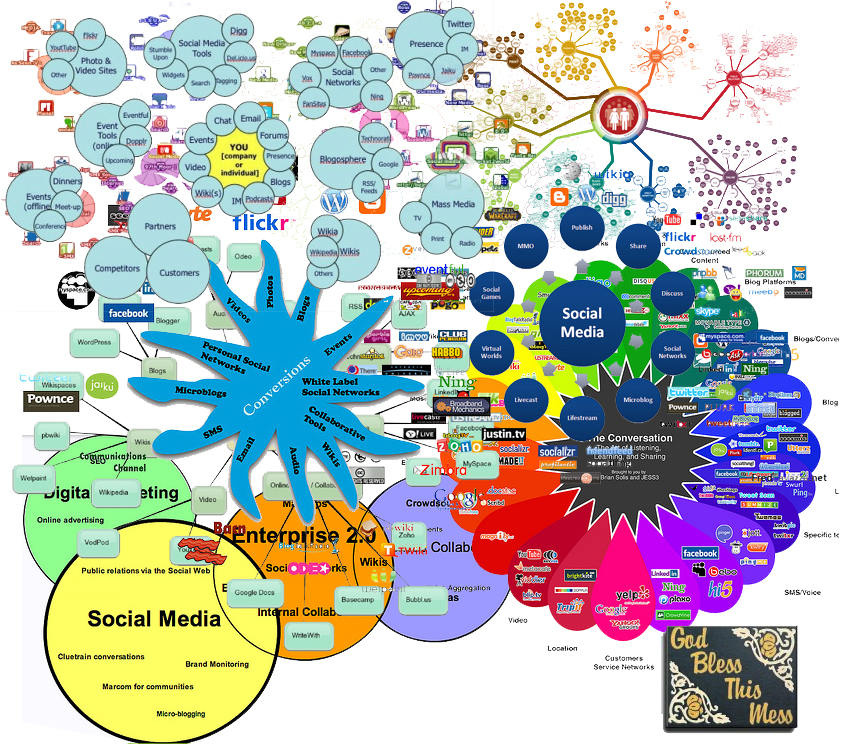
Tom Cunniff's Ultimate Social Media Diagram, 2008
For #adjunction series and other (but not all) "informationist" projects, I collect adjunct links that I bundle as an #adjunction series. Each bundle has a web page with a permalink. Here's the most recent link bundle page in the series: #adjunction Jan2016 #4, 17 links

Informationist projects: throughout 2015 I've been referring to this blog and the associated network as an independent information network. That is my focus...among other intentions.

Tuesday, August 21, 2012

Killing -- And Reviving -- The American University in Five Easy Steps - Forbes

Debra's Famous #5Steps Makes Forbes! How often does an academic from a discipline other than business, economics or IT, an adjunct, especially one in the arts and humanities, manage that? 

Opening with HG Wells quote,"History is becoming more and more a race between education and catastrophe" (the same as Lingenfelter's report), Steve Denning (Forbes Contributor, Radical Management: Rethinking leadership and innovation) writes,
Debra Leigh Scott has written an insightful article about the decline and death of the American university. Even more important is to think through how we revive it. 
Ms. Scott starts from the period post World War II, i.e. the 1950s when the GI bill, and the affordability — and sometimes free access — to universities created an upsurge of college students across the country. This surge continued for a time. Colleges had a thriving professoriate, and students were given access to a variety of subject areas, and the possibility of broad learning. Then something went wrong. 
It happened, she says, in five easy steps.
Read the rest and commentary at Killing -- And Reviving -- The American University in Five Easy Steps - Forbes

Friday, June 29, 2012

Professors Say the Darndest Things!

All higher education faculty need to come together in sincere and forthright dialogue. 

Now.

And what I have in mind, in case there is any mistake, is a sincere and forthright dialogue between these two faculty groups:

Friday, June 1, 2012

Joe Berry's COCAL Updates, May29

... featuring news & links on #ContingentFaculty & #organizing #AcademicLabor in #highered. To subscribe to regular Updates, email joeberry@igc.org.  More about Joe Berry.  Updates are also archived at chicagococal.org. Follow COCAL International on Facebook 

Updates in brief and links

Around the Adjunctiverse...

Adjunct fired at Texas A&M (Daily Mail, UK), a public university, as indirect result of objecting to cross displayed on top of university building (e.g. files complaint with ACLU that leads to removal of crosses and subsequent email threats that administration does not act on but reacts by taking away her fall courses for speaking out), as recently reported in Crosses, Threats and an Adjunct by Scott Jaschik (Inside HigherEd). See also Seth Kahn's impressive letter to San Antonio Texas A&M administration (Adjunct Project). Breaking update: she is now in communication with The Fire, which took an immediate interest in the case.

Raritan Valley CC (NJ) adjunct union to protest at trustees meeting lack of progress in negotiations for contract.

Duquesne, Pittsburgh, adjunct union (USW) to have NLRB representational election in June-July, by mail; post by USW organizer on organizing adjuncts, at the Adjunct Project. FYI, organizer also interviewed for 'Junct Rebellion film.

Kalamazoo CC (MI) adjuncts vote overwhelmingly for union rep by AFT local

Tuesday, May 15, 2012

The Power of Two: Leveraging Academic Senates and Faculty Unions

... strategizing unofficially for #CFHE, Campaign for the Future of Higher Education, post by Teri Yamada, Professor of Asian Studies, originally appearing at Restructuring Public Hi Ed
The challenge for government, universities, and unions is to recognize that while the environment is changing and the pressures are intense, adaptations must be made in ways that ensure that short-term fixes do not compromise sound public policies, such as the right to form associations and collectively bargain. Nor can short-term fixes be allowed to compromise fundamental public priorities, including access to an affordable, high-quality college education, and prudent, long-term financial planning by the government (1).
(image above) Student arrests during protest against tuition increases, Nov. 17, 2011, CSU Board of Trustees meeting. Photograph by Stefan Agregado
....

Monday, April 2, 2012

Joe Berry's COCAL Updates 31March12


COCAL Updates in brief & links 


Note: Call for Papers (also as attached pdf) for COCAL X, August 10-12, Mexico City. Follow COCAL International on Facebook.  Email joeberry@igc.org, to subscribe to regular updates in brief and links by email. More about Joe Berry.   

Mundo Precario

Monday, March 19, 2012

Joe Berry's COCAL Updates 17Mar12


Email joeberry@igc.org, to subscribe to regular updates in brief and links by email. More about Joe Berry. 

Updates in brief and links

LABOR*ED
The war on teachers (by a very good labor historian Mark Naison). WaPo.

Labor Heritage Foundation presents its own Great Labor Arts Exchange, Conference on Creative Organizing, and Camp Solidarity June 22-25, 2012 located this year at Conference Center at the Maritime Trades Institute, just outside of Baltimore, MD.    

We are looking for presenters, workshops, and participants for our June annual gathering now in its 34th year and shaping up to be a very exciting program.  Register now for the early bird special rate of $99.00 (regular) and $75.00 (for students, youth, and seniors). The Great Labor Arts Exchange is a gathering of union and community activists, rank and filers, organizers, cultural workers, artists, labor educators, and youth who use, or support the use of, songs, art, poetry, theater, skits, posters, cartoons, and film to strengthen the labor movement.  You don't need to be an artist or performer to attend or perform! 

Registration information, now being taken online. Follow us on Twitter at @GreatLaborArts ~ Strengthening the labor movement through the use of arts and culture...and creative organizing 

Sunday, March 4, 2012

Reading Room: about reading highered + links of my own

Yes indeed, Joe Berry's COCAL Updates, Omnivore and Michael Meranze's "In case you missed it..." (Remaking the University) links are fine and dandy, but I have a feed reader too and links of my own, collected here for a change. This might also explain why I might miss articles in IHE and CHE and run short of time to pore over comments. News Flash! Not everyone in the universe checks them or even the Grey Lady first thing.

So much more is written about higher education, contingent workplace conditions, education and the economy than on just those august pages. Depending on either or even both for all your higher and other education news is just another way to stay trapped in the Ivory Silo©. Think too of the great adjunct writing online that doesn't make it into those pages. Why let commercial, advertising soliciting gatekeepers dictate what you read? Look for the Adjunct Label...


Saturday, February 25, 2012

Reading Room: Omnivore on highered, academic publishing, online ed & more


Outlets for scholarly work


From the Village Voice's Education Supplement, a special issue on bursting the tuition bubble. The Occupy movement took hold at some campuses, and students are still holding their ground— but how strong is their will? A look at what the Top 1% of earners majored in. Every year, JSTOR turns away 150 million attempts to read journal articles (and more). Rather than restricting access to publicly funded scientific research, the rule should be — if taxpayers paid for it, they own it. Clever people have figured out that there is a growing demand for outlets for scholarly work; as a result, there has been a proliferation of new publishers offering new journals in every imaginable field. Kill peer review or reform it: It's only a matter of time before people rise up against the conventions of traditional journal publishing. Richard Price, founder of Academia.edu, on the future of peer review. Felix Salmon on Udacity and the future of online universities (and part 2). What you (really) need to know: The digital age has changed more than how we learn — it’s changed what we need to learn. Blogs vs. Term Papers: To raves and rants, blogging has become a requirement in everything from MBA to literature courses.
Shamelessly reposted in toto from Omnivore, the Book Forum blog. Best and smartest, eclectic curated collections of annotated links. Want more, from a cross section of popular and scholarly sources and on a variety of topics? Head on over, bookmark, subscribe, visit regularly.

Friday, October 21, 2011

Reading Room: An unsettled moment in #highered

Found the Omnivore piece below languishing in drafts, hopefully not too late. Scott McLemee's Occupy piece may seem a tad outdated and even superseded by now. However, with the International Student Movement's November 7-20 Global Weeks of Action just around the corner, the piece is still timely, a reminder of the global. 


What a fall calendar: Campus Equity Week 2011 next week (and still resources and exhortations to post!); then Campaign for the Future of Higher Education the 1st weekend in November with ISM actions starting the very next week and peaking November 17 on International Students Day... all against the backdrop of ongoing Occupations. Is it just me or could movements use "action planners" to coordinate schedules? What about cooperative actions?


And the rest? Hate, humanities, culture wars, information overload, protests... all relevant. Mind the ellipses: you know the drill. Here four means at least one link. Catch the missing ones online

Thursday, September 29, 2011

Upcoming Conferences on #Highered Issues

Some upcoming events posted on the Academe blog, with the request that you email at academeblog@aaup.org if you have events to recommend. Please share them with us too. We're trying to develop a national event calendar and plan to add a calendar feature to the newsletter. Post questions and event recommendations in comments. The following list does not include contingent faculty issue panels or sessions at professional and discipline specific association meetings. We welcome adding those to our list too.

Posted via email from Academentia

Saturday, March 5, 2011

English Department of the Future

The time: some decades hence.
The place: The University of South Jetsonville, a large state university.
The Grand Administrator is speaking to one of his minions about what used to be called the English Department. Although there are four faculty members who still comprise the "English Department," most of the department, and its chair, have been "restructured" and have disappeared in the name of increasing efficiency. Curiously enough, the number of administrators has only increased. We enter in the midst of the conversation.
The Grand Administrator: "What can you tell me about how we're achieving excellence in the English Department?"
Minion: "Well, our single section of English 101 is a success. The accrediting agency is happy that we have moved to weekly Scantron grammar quizzes instead of actual writing, since it's impossible to be accredited without measurable outcomes. There's nothing more measurable than a quiz."
It gets 'better' ~ read the rest at notofgeneralinterest.blogspot.com


From April 2008, so either prescient or just another case of the le plus ça change le plus c'est la même chose. That or, quoting Gen DeGaulle, ça c'est le chit en lit. Inspired by discussion of tenureless university, closer now than it was then. The scenario is equally reminiscent of a certain rural NM branch campus, cuyo nombre no quiero acordarme, circa 2003.... and no doubt innumerable others of its ilk


Tuesday, January 25, 2011

New to the higher ed beat? Read this.

links from the Educated Reporter blog for following higher ed news. No, you may not agree with the editorial stance of every source listed. So what. Since when did depending on mainstream corporate media and cherry picking sources for consensus constitute good research?


I'd add academic, labor and other blogs to the source list but that's another post. What sources would you add? The Educated Reporter, Linda Perlstein, public editor for the Education Writers Association, writes, 
Last week I posted resources I think are helpful for K-12 reporters to stay abreast of national issues. Today, here is what I recommend to new higher ed reporters: 

  • —You simply cannot cover the beat without signing up to receive daily bulletins from Inside Higher Ed and the Chronicle of Higher Education. It would be like obsessing over celebrities without reading People and Us. Touring Provence without visiting Aix or Arles or Avignon. (Oh wait, I did that once, but I had my reasons.) Everything on IHE is free, and the Chronicle gives journalist free subscriptions and is very generous about lifting you over the paywall for links and such.
  • —Lumina Foundation send out links to the day’s higher ed headlines—unfortunately, only the headlines, but it is something.
  • —Blogs worth reading: Joanne Jacobs on community colleges at Hechinger, Quick and the Ed, the New America Foundation blogs, Mike Kirst’s College Puzzle, Center for College Affordability and Productivity, and, if you are into admissions issues from a consumer perspective, The Choice at the New York Times.

What am I missing? 

Comment:

Other worthwhile bulletins:

  • _University Business Magazine's daily newsletter, which thoroughly rounds up higher-ed news stories sandwiched between job postings, new product announcements and contracts: http://bit.ly/awGikF
  • _ The National Association of Independent Colleges and Universities compiles top headlines and links daily ... even though today its Twitter feed promoted an opinion piece in a North Dakota newspaper that badly distorted a recent AP story on collegiate learning. www.naicu.edu/rss/newsroom.asp
  • _ The American Council on Education's Division of Government and Public Affairs sends out headlines/links twice a week: http://bit.ly/i2Rgpr 
You won't miss much if you get these.

Wednesday, January 12, 2011

Learning Analytics: a foundation for informed change in Higher Education

Agreeing with the methodology, validity or purpose of Learning Analytics and Educational Data Mining is not necessary.

What is necessary: not ignoring them or their implications for the future of higher ed. Consider them tools you too can use.

故曰:知彼知己,百戰不殆;不知彼而知己,一勝一負;不知彼,不知己,每戰必殆。
So it is said that if you know your enemies and know yourself, you can win a hundred battles without a single loss.
If you only know yourself, but not your opponent, you may win or may lose.
If you know neither yourself nor your enemy, you will always endanger yourself.

Learning Analytics: EDUCAUSE

View more presentations from gsiemens.

So what is to be done? Learn. Try LAK11, the MOOC.

Monday, January 10, 2011

Another MLA Online Roundup « Post Academic

Still no personally crafted MLA Convention-from-afar round-up, instead I spent the day community blogging, researching a story on, would you believe, the local Chamber of Commerce (which displays the same stunning disregard for transparency as highered admin), setting up for and settling into a couple of open online classes/workshops, one an experimental online super-mega-class, a MOOC.

Both delivery and subject for this last course, Learning and Knowledge Analytics, have major implications for the future of highered and academic labor. Why am I doing it? Curiosity, it's free, definitely a change of pace and, unless you are into ostrich, relevant.

Anyway, back to Post-academic's excellent MLA Convention roundup...

Image Source,Photobucket Uploader Firefox ExtensionI would have made this a Twitter roundup, but the #mla11 feed is admirably polite and professional, aside from concerns about cliquishness among a certain group. To which I say, this is a convention, not high school, so make your own group if you don’t like the dominant group. It can be done. It’s a large convention, not a cafeteria. Watch “Police Academy” or “Stripes” or any other inspiring misfit comedy, take some notes and call me in the morning.

Anyway, on to the roundup:

The message of the digression (yes, intended or not, there's a message, or subtext if you prefer): nice to hear about the convention, but we all still have lives. Haven't checked recently, but not much about #mla1 on the adj-l list, not even about the "Academy in Hard Times" opening day initiative. A different quantum universe.

Posted via email from Academentia

Sunday, January 9, 2011

the academic divide

I'll get back to MLALA, Boston AHA and other convention follow-ups tomorrow or whenever the blog and media post-mortems roll in to supplement in-the-moment twitterati observations, not to mention the wealth of links on the rss reader to sort. In the meantime, Ominvore's annotated, academic-themed links fill the gap.

Communicating across the academic divide: Universities must nurture interdisciplinary relationships, which can lead to creative ideas that could fuel the economy's long-term health. Are English departments killing the humanities? From Minding the Campus, Russell K. Nieli on why Caltech is in a class by itself. What does a relationship between the intuitive symbolic work of children and the design of contemporary technologies mean for the academic world? The man who financed Facebook is offering 20 two-year $100,000 fellowships to teenagers with big ideas — as long as they leave university. An article on the 7 most important classes to take in college. With a cross-disciplinary approach to education, we can train a new class of problem-solvers to address current global challenges, from poverty to climate change. No talking in class: Campus liberals sacrificed free expression on the altar of political correctness. What happens when college is oversold: Why are more and more college graduates not entering the class of professional, technical and managerial workers that has been considered the main avenue of employment? An interview with Ronald A. Smith, author of Pay for Play: A History of Big-Time College Athletic Reform. For-profit college companies are taking in enormous amounts of federal student aid money by recruiting and enrolling members of the military, veterans and their families, with questionable returns.

Posted via email from Academentia

Tuesday, December 28, 2010

the state of higher education

...segues into obligatory season version of the ubiquitous "whither U" conversation ~ whether rant, lecture or dialog. Our New Year's resolution (another obligatory seasonal genre) should be moving it from rant and lecture to inclusive dialog. By inclusive, I mean not leaving adjuncts, contingent and NTT academic labor out of the national discussion and decision make. Don't just toss an occasional hush puppy panel or even all day bone to the noisy dog.

Anthony Grafton reviews Higher Education? by Andrew Hacker and Claudia Dreifus and Crisis on Campus by Mark Taylor. Is going to an elite college worth the cost? The sluggish economy and rising costs of college have only intensified questions about whether expensive, prestigious colleges make any difference. Michael Konczal on the 21st-century retreat from public higher education. The academy as a commodity: What if the market has already devalued the knowledge on which the entire operation of accountability is based? From Arcade, Gregory Jusdanis on the oppression of peer review. Academics have long been criticised for being out of touch with the real world; many make great efforts to dispel ivory tower attitudes, but others believe such habits will never disappear. An interview with Phillip Brown, Hugh Lauder, and David Ashton, authors of The Global Auction: The Broken Promises of Education, Jobs and Incomes. The disposable academic: Why doing a PhD is often a waste of time. Can Tolstoy save your marriage? Cultural classics offer vital lessons about how to live, but our universities don't teach them that way. An interview with Martha Nussbaum on the value of the humanities (and more). Victor Davis Hanson writes in defense of the liberal arts: The therapeutic Left and the utilitarian Right both do disservice to the humanities. We're all conservatives now: Academics from the left and right blame each other for the state of higher education, but they're in agreement more than they realize.

Our part is to come to table stunningly well informed: homework done, all sides researched ~ add well articulated objectives to the list. Hence the timeliness of yet another review.

Coming up in this seasonally appropriate Janus series: an adjuncts' top 10 list for 2010, maybe even best and worst lists. Then if not resolutions, directions and realistic objectives for 2011.

What's on your list?

Posted via email from Academentia

Tuesday, November 9, 2010

What Happens if the Charter School Companies Win?

Among the arguments made by advocates for charter schools is that they expand consumer choice and that given the state of education in many inner-city minority communities experimentation with alternatives can only help the situation. As buzz words, choice and experimentation always sound good. After all, we know about the disappointing performance of many students in inner-city schools under the current educational system so why not try something else?

Unfortunately, we already know what will happen if private-for-profit charter school companies take over K-12 education in the United States because for-profit proprietary companies have already successfully invaded what used to be called "higher education." These companies have defrauded the government, left families deep in un-repayable debt, and cheated students out of an education.


Higher ed and K-12 are connected ~ what goes down in one, affects the other; "innovations," policies, programs, etc. implemented in one domain will eventually come home to roost in the other, trickle up or trickle down. It behooves each to trend watch the other.

Posted via email from Meanderings

Friday, October 8, 2010

Reading the University Classics, Part 2

This is either an admittedly indirect follow up or counterpoint to yesterday's October 7th actions kicking off a "global wave of action for education." I haven't decided which yet. Perhaps I'll have a clearer notion after post-7 rss feed reader skimming. Until then... history. Student actions are part of the history of the institution's history. Long preceding last century's 60s student actions, there was another set student and youth actions the century before.

Ortega y Gasset was the previous and 1st entry in this series. Did you know that Thorstein Veblen wrote about the university too?

Careers Library/Books Illustration

"From the distance of more than half a century, Karl Jaspers's 1946 treatise, The Idea of the University, reads both like a farewell to the 19th-century German university and a lucid anticipation of several of today's academic problems.

Jaspers wrote his book at the end of World War II. The Nazis had suspended him from his position as professor of philosophy. One of his reasons for writing this treatise was to lay the groundwork for a thoroughly democratic restructuring of higher education in Germany. However, Jaspers also insists that the university is a genuinely transnational institution and that his elaborations concern higher education everywhere."

CHE Editor's Note: This is the second in a monthly series intended to introduce new generations of faculty members and administrators to a core set of classic books about higher education and its institutions.

Wednesday, February 24, 2010

online reading for wayward perma-temps

No, I haven't forgotten about the blogroll... still collecting, tagging, sorting, etc. A March 4 post from new adjunct blog, The Adjunct Voice. described as "a virtual meeting place for part-time/adjunct university faculty members from across the U.S. to have a voice... share... ideas, experiences and concerns" opens today's online reading list for wayward perma-temps. Each post "My name is Raye, and I am an adjunct"

Day of Action for Education event heating up for March 4. Do you know of a March 4th activity in your area? Please add it to her list.

CalFac list of March 4 actions

The Case Against College Education ... but for certification. If TIME is in favor of it, can group think be far behind?

1st the dot.com bubble, then the real estate bubble: now comes the student loan bubble, Bob Samuels in HuffPo

Share Your Story @ HuffPo - Majoring In Debt

Scientific American: Academic Labor Market Gone Seriously Awry
Related Posts Plugin for WordPress, Blogger...