…moderated by #KeithHoeller and Kathryn Re…featuring Frank Cosco and Jack Longmate.

The teach-in addresses multiple inequities built into the two faculty system and possible solutions.


 …and the intense experience of participation and immersion in social and digital media surrounding what was an epic event. Everything else, including this blog. went on hiatus or minimal maintenance, depending on how involved it was with event support and coverage. Stories and posts are still coming in. The National Adjunct Walkout Day Tumbler is still open and accepting submissions.
 …a revisited and only moderately updated 2011 newsletter article that, given distribution and placement, I should have blogged here in the first place. So now, thanks to #NAWD and revived Teach-In interest, I'm getting to it. Defend Public Education emerged in 2009, grew, peaked in 2011 and then seemed to fade into Occupy ~ now in eclipse as well. The teach-in / walkout connection is clearer now.
 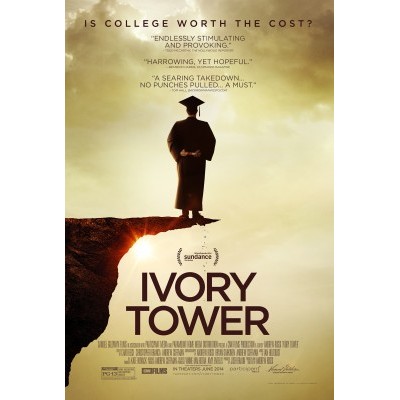 I just finished watching Ivory Tower online but should watch it again when I am not multi-tasking. It's definitely on the recommended list. Yesterday, when CNN aired the documentary, my viewing plan was watching skimpy clips and reading reviews. I don't often wish for cable or TV: don't miss the latter; never had the former so can't really miss it. This morning David Millroy's post to the CPFA list about watching Ivory Tower sent me looking for longer clips. Lo and behold...seek and ye shall find. Sometimes.
 …is the Big Red A giving National Adjunct Walkout Day a thumbs up, hitchhiking or getting ready to walk? I've been collecting links and tweets for a Storify (that I'd better get to before it goes as jumbo out of hand as the COCAL XI Storify) and am also working on a handful of related posts (including but not limited to a history of the Big Red A, Why February ~ another history, and the Adjunct alphabet game). The links are to a) tide you over until then, and b) remind you to check out, follow, share and, most especially, join conversation on any one or all of the main Walkout Day locations (discussion board, Facebook page, Event page, Twitter stream and hashtag) below
 …not in any particular order, not by importance, chronology, category or other ~ just as they flit by or come to mind. The operating idea is to turn out a quick update post. Morning would have been nice but we missed that window. Don't think of it as regular item either unless you see it appearing multiple days in a row. How hard can it be to snag a few from the morning flow to start the day with? Not pick, not select.
 …not the only item on the PF blogging agenda, which includes National Adjunct Walkout Day, Adjunct Chat's PD project, #ccourses ~ among other topics. Since this is Bullying Prevention/Awareness Month, I did not want to delay opening a long planned academic bullying series post. Although most of the months' designated websites emphasize schools, bullying and mobbing ~ as many of us know all too well ~ is very real in academic workplace too.
October is National Bullying Prevention Month, in which schools and organizations work together to stop bullying and cyber-bullying through activities, outreach and education. The month not only tries to raise awareness of bullying in schools, but also works to raise awareness of workplace bullying.So is bullying in online groups and volunteer organizations. Building and maintaining trust is central to both organizing and preventing online bullying. Whether serendipity or morphic resonance, today's #ccourses' webinar is about building trust online and off. That will probably be the next post in the series. Reading Room will feature related links this month, and I hope to get to at least some of the bullying and related posts in drafts

Eric Hartman (Kansas State) and Antoinette Hertel (St. Joseph’s): Clearer Thinkers, Better People? Unpacking Assumptions in Liberal Education. Who needs a liberal education? Gilbert Meilaender on why we should stop pretending that the liberal arts are important frosting on the cake of an education that is in fact designed for other purposes.
An excerpt from Beyond the University: Why Liberal Education Matters by Michael Roth. Why Scott Samuelson teaches Plato to plumbers: Liberal arts and the humanities aren't just for the elite. The humanities aren't obscure, arcane or irrelevant — they awaken our souls, influence how we think about inequality, and help us adapt to a changing world.re-blogged from who needs a liberal education? - bookforum.com / omnivore ~ head on over and read the rest there

Warner began her account by describing the visit of a friend from California who noticed that the library (from the 1960s) had been built in the style of the "new brutalism" (Think of most old UC or CSU buildings). But as Warner herself notes, "new brutalism in academia was taking on another meaning." Although it has happened with ruthless ideological will in England, it is not an alien story to the US. Indeed, what has happened over the last few years under David Cameron is really just a fast-forward version of what has been going on in the US more slowly and in less centralized fashion. We are in the midst of our own new brutalism. Although not as centrally directed we have been witnessing it for years: the recent intrusions by governing boards at the Universities of Illinois, Kansas, and Virginia; the shuttering of small language departments; the dramatic rise in tuition at public universities; increasing student/faculty ratios; ever growing reliance on adjuncts; cuts in Federal support for scholarly research; and our own, albeit less developed, auditing system. In England, the transition occurred with such speed as to catch most people off-guard (despite the efforts of individuals like Stefan Collini, Andrew McGettigan, or the Campaign for the Public University). But we have no excuse.This is the time to master the details to be able to oppose the systems being put into place on campuses across the country. [emphasis added]

 …late again. With Palestine and Salaita so much in international and higher education news, Edward Said comes to mind now. In addition to sharing Cairo, there are a few once removed connection ~ the talismanic "friend of a friend." The film, a series of interviews, is long—very much worth the time watching—but you might want to take a break or watch in more than one sitting.
There can be no true humanism whose scope is limited to extolling patriotically the virtues of our culture, our language, our monuments. Humanism is the exertion of one's faculties in language in order to understand, reinterpret, and grapple with the products of language in history, other languages and other histories. In my understanding of its relevance today, humanism is not a way of consolidating and affirming what 'we' have always known and felt, but rather a means of questioning, upsetting, and reformulating so much of what is presented to us as commodified, packaged, uncontroversial, and uncritically codified certainties (28).


| Florilegium © Robert Amesbury |
 …on Central American Immigrants, Indonesian Presidents, Federal Employment and more in this week's Democracy Chronicles newsletter. As blogger, social media content curator/editor and Precarity Faculty Network coordinator, I subscribe to many weekly and daily email newsletters in addition to following social media and blog feeds. I don't -- can't -- blog all the newsletters but do try share as many as possible on social media and introduce you to selected newsletters by blogging samples.
  Today is another movie day on the blog ~
BYOP(opcorn). Leading up to #cocalXI ~ or #altCOCAL, even both,
depending on your inclinations (but that's another post), the current Sunday Matinee series focuses on
Barbara Wolf's films about adjunct academic labor, which have been
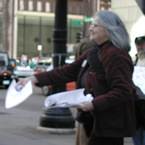
closely associated with COCAL since the first Campus Equity Week in 2001, where Degrees of Shame: Part-time Faculty: Migrant Workers of the Information Economy was shown in Chicago (and became a CEW staple). The afterword to A Simple Matter of Justice was taped at COCAL IV in San Jose, CA. In the picture to the the right, Barbara Wolf is handing out flyers in Chicago.
Today is another movie day on the blog ~
BYOP(opcorn). Leading up to #cocalXI ~ or #altCOCAL, even both,
depending on your inclinations (but that's another post), the current Sunday Matinee series focuses on
Barbara Wolf's films about adjunct academic labor, which have been
closely associated with COCAL since the first Campus Equity Week in 2001, where Degrees of Shame: Part-time Faculty: Migrant Workers of the Information Economy was shown in Chicago (and became a CEW staple). The afterword to A Simple Matter of Justice was taped at COCAL IV in San Jose, CA. In the picture to the the right, Barbara Wolf is handing out flyers in Chicago.


